

Every year, phone launches lead with a new chip name and a chart full of percentage gains. This year the charts are bigger than usual — and, for once, some of the gains are the kind you can actually feel in daily use. The late-2026 flagship wave, including phones such as the Motorola signature 27 on a Snapdragon 8 Elite Gen 6-class platform and OPPO’s latest Dimensity-powered flagship, is built around three promises: much stronger on-device AI, better efficiency instead of just more speed, and cameras that squeeze more out of the same sensors.
One honest note before we start: exact chip names and variants differ by brand and region. The same phone can ship with a different processor in different markets, and makers sometimes use slightly different versions of a chip in different models. So instead of chasing names, this guide explains what each part of a modern flagship chip does for you — and which upgrades are worth paying for.
The Parts of the Chip, in Plain English
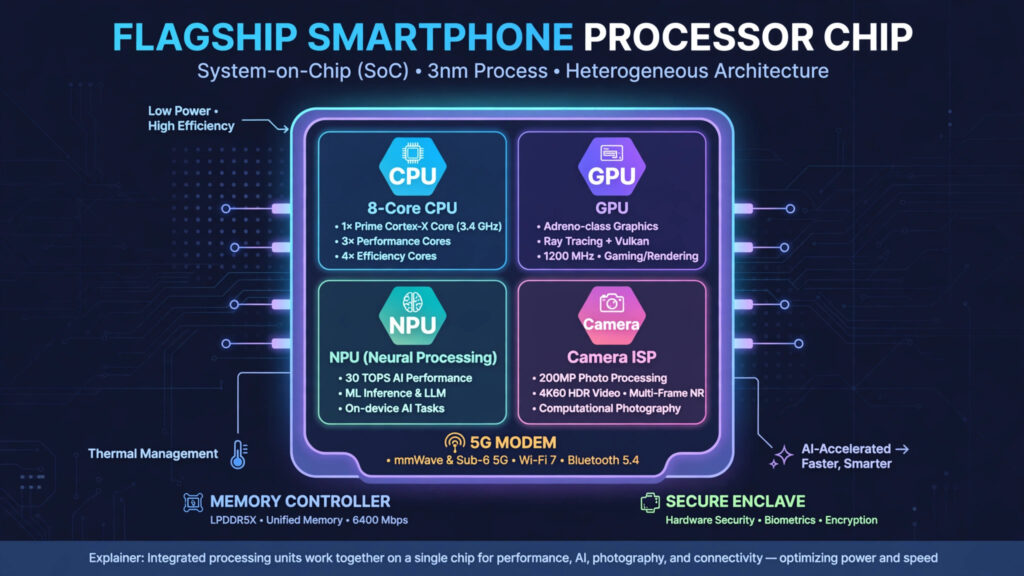
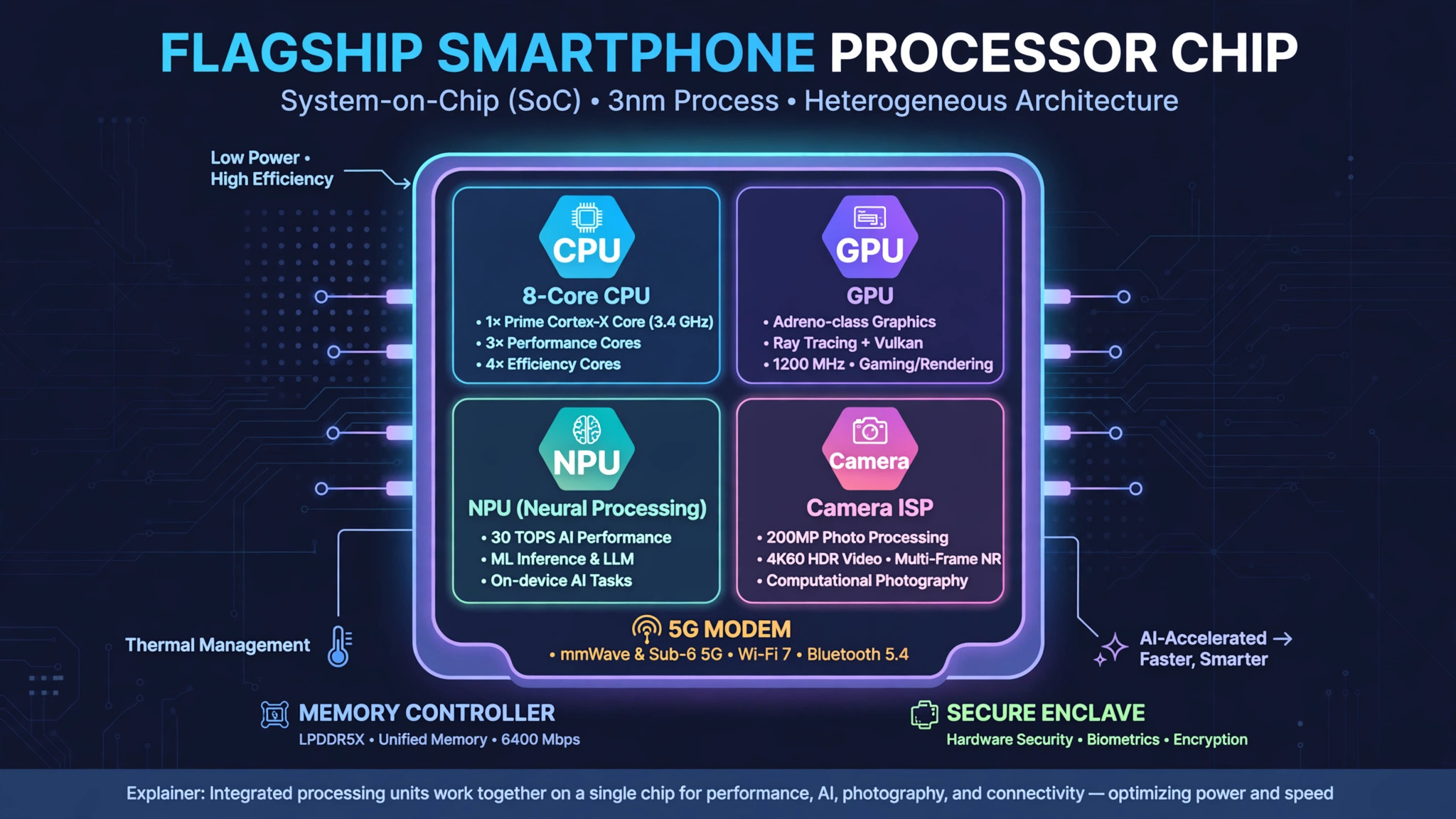
A phone’s processor is not one thing. It is a package of specialised parts sharing one piece of silicon:
- CPU — the general worker. It opens apps, runs the system and handles everyday tasks.
- GPU — the graphics worker. It draws games, animations and the interface itself.
- NPU — the AI worker. It is built for the maths behind translation, photo cleanup, voice recognition and similar AI jobs.
- ISP — the camera worker. It turns the raw signal from the camera sensor into the photo you see.
- Modem and connectivity — the radios for mobile data, Wi-Fi and Bluetooth.
Older chip generations mostly competed on CPU and GPU speed. This generation’s biggest jump is in the NPU and the ISP — which is why the marketing sounds different this year. The race is no longer only about how fast the phone is. It is about what the phone can do by itself, without help from the internet.
What the NPU Jump Means in Daily Life
For years, most impressive AI features worked the same way: your phone sent the job — a voice recording, a photo, a sentence to translate — to a powerful server in the cloud, waited for the answer, and showed you the result. That works, but it needs a connection, it adds delay, and it means your data leaves the device.
A much stronger NPU changes the balance. More AI can now run on the phone itself:
- Live translation during calls and conversations, without waiting for a server round trip.
- Photo cleanup — removing a stranger from the background or fixing a blurry face — processed locally in seconds.
- Voice notes and recordings transcribed and summarised on the device, even in airplane mode.
- Writing help and smart replies that respond instantly because nothing is uploaded first.
Why does local feel faster? Because the slowest part of cloud AI was never the thinking — it was the journey. Uploading a photo, queuing on a server and downloading the result takes time and fails completely in a lift, a basement or a village with weak signal. On-device AI starts immediately and works offline. There is a privacy bonus too: a voice note that never leaves your phone cannot be stored on someone else’s server.
This is also the hardware behind the shift from chatbots to agents. If you have read our explainer on agentic AI phones, you will know the new assistants try to complete tasks — booking, ordering, organising — rather than just answer questions. Those assistants still use the cloud for hard jobs, but the quick, private, always-available layer they lean on is the NPU in your pocket.
Efficiency Is the Real Battery Story
Here is the part of the launch presentations that matters most and gets explained least. A new chip built on a newer manufacturing process can do the same work using less power. Opening the same apps, scrolling the same feeds and shooting the same photos simply costs less battery than it did on last year’s chip.
That is a different kind of gain from a bigger battery — and the two multiply together. This generation pairs efficient chips with the new high-capacity cells we covered in our guide to silicon-carbon batteries. Efficient chip plus bigger battery is how phones now promise the kind of endurance that used to need a bulky power bank in your bag.
Gaming: sustained speed beats peak speed
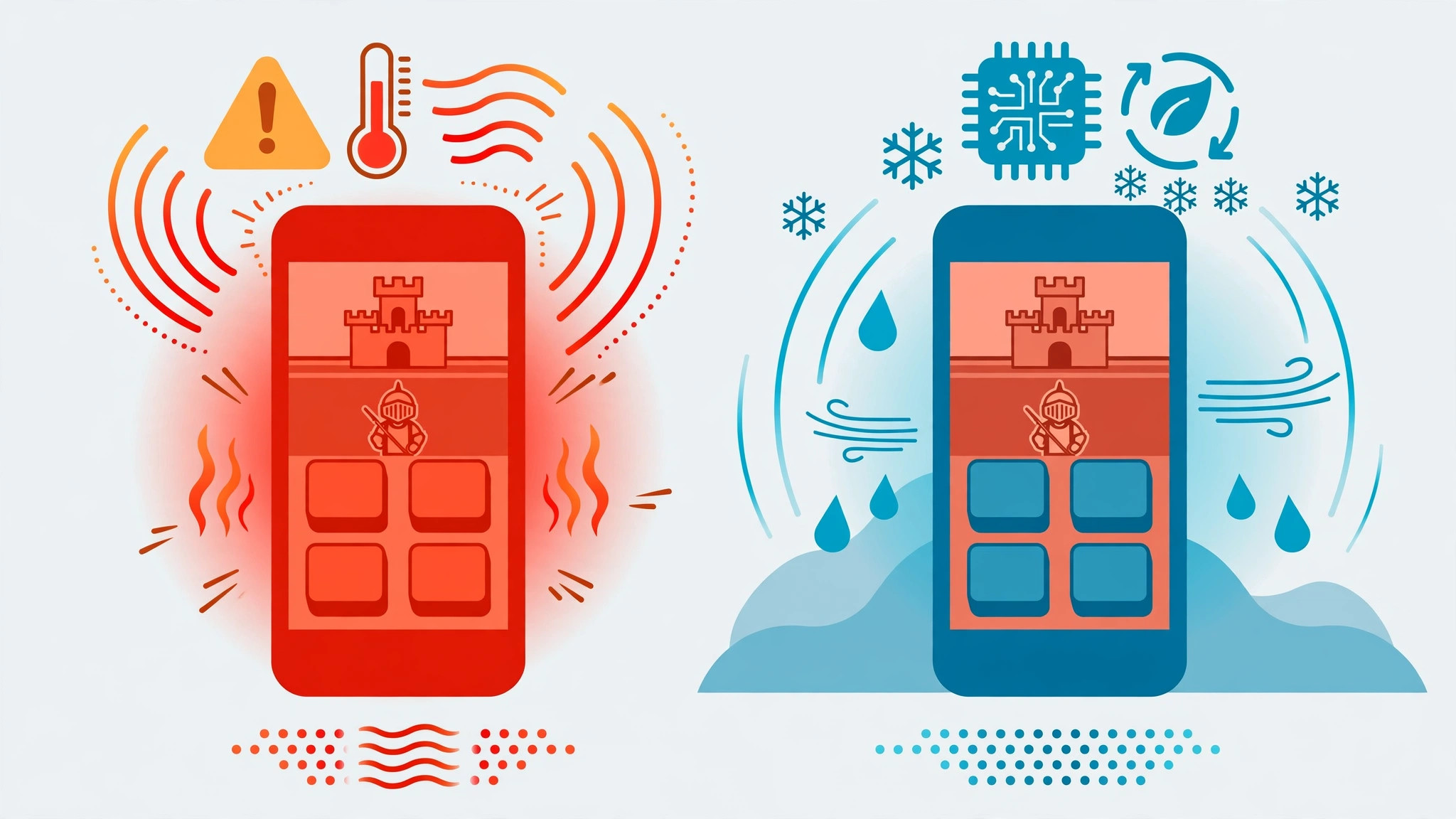
Efficiency also fixes gaming’s oldest problem: heat. Any chip can run flat-out for two minutes. The question is what happens at minute twenty, when the phone is warm and the chip slows itself down to stay safe — the dreaded throttling that turns a smooth game into a stuttering one.
A more efficient chip produces less heat for the same frame rate, so it can hold its speed for longer. For players, that is the upgrade that actually shows: not a higher score in a two-minute benchmark, but a match that still runs smoothly at the end. If you do not play heavy games, you will feel the same efficiency in a quieter way — a phone that ends the day at 30% instead of 8%.
Why the Same Camera Sensor Takes Better Photos
Here is a fact that surprises people: phone makers often keep a similar camera sensor for more than one generation, yet the newer phone’s photos look clearly better. The difference is the ISP — the chip’s camera brain — and the software working with it.
Every photo you take is heavily processed before you see it. The ISP merges multiple exposures, removes noise, balances colour and sharpens detail, all in a fraction of a second. A faster, smarter ISP can merge more frames and make better decisions, especially in the hardest situation of all: low light.
Google’s Pixel 11 and its faster Instant Night Sight is the clearest example of this software-plus-chip teamwork. Night modes used to mean holding the phone still for several seconds while it gathered light — fine for a building, hopeless for a moving child or pet. Doing the same job almost instantly means the processing is fast enough to freeze the moment instead of blurring it. When a review says a new phone has “better night photos with the same sensor,” this is what happened: the brain got better, not the eye.
Wi-Fi 8: Fast on Paper, Decided by Your Router
This chip generation also begins the move to Wi-Fi 8. Motorola, for example, claims speeds up to twice as fast on its new flagship platform. Numbers like that are real in a laboratory — but there is a catch that no launch presentation mentions.
Your phone can only use Wi-Fi 8 if your home router supports it too. Connect a Wi-Fi 8 phone to the router your internet provider gave you three years ago, and it will politely fall back to that router’s older standard. The phone’s new radio sits mostly unused until the router is replaced — and for most homes, the current router is not the bottleneck anyway; the internet plan is.
So treat Wi-Fi 8 as future-proofing, not a reason to buy. It is genuinely good that the support is arriving now, because a flagship is a three-to-five-year purchase. Just do not expect a speed miracle on day one unless you also plan a router upgrade.
Who Should Actually Care — and Who Should Not
Let us end with the buying advice the launch events will never give you: last year’s flagship chip is still excellent for most people. If your phone is one or two generations old and does everything you ask, this year’s chip will not change your life. Social apps, messaging, video, banking and ordinary photography were already fast.
The people who genuinely gain from this generation are:
- Heavy gamers, who feel sustained performance and lower heat in every long session.
- Frequent travellers and field workers, who use live translation, offline voice transcription and on-device AI where connections are unreliable.
- Night and action photographers, who benefit from the faster ISP every time the light drops.
- Anyone whose current phone dies before the day does — efficiency plus a bigger battery is the first upgrade in years that attacks that problem from both sides.
Everyone else can buy last year’s flagship at a discount, or wait, with a clear conscience. The honest summary of the new flagship chips is this: the AI is finally local, the battery gains are finally real, and the camera improvements come from brains rather than bigger numbers. That is a good generation — just not a compulsory one.