
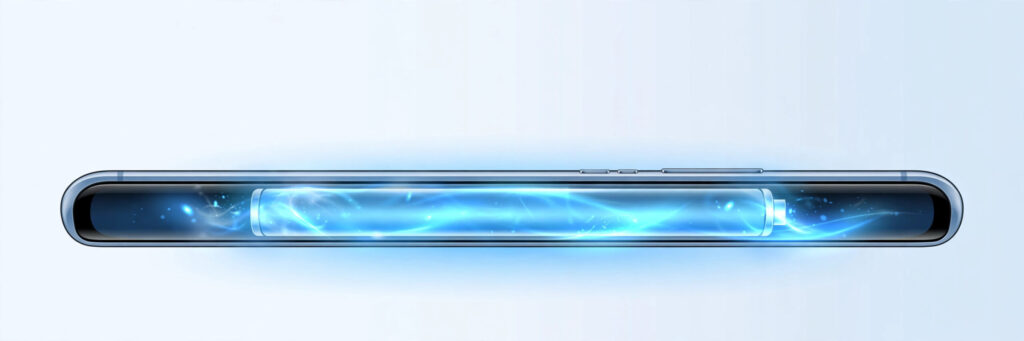

For about a decade, flagship phones settled into the same routine: a battery somewhere between 4,500 and 5,000mAh, a body around 8mm thick, and a promise that software would stretch the charge through your day. Then suddenly phones started arriving with 7,000mAh and even 8,000mAh batteries — in bodies no thicker than last year’s models. What changed is inside the battery itself, in a part most buyers never think about: the anode. The name for the new approach is the silicon-carbon battery — and once you understand it, 2026 spec sheets make a lot more sense.
How a Normal Lithium Battery Stores Energy
Every phone battery you have ever owned is a lithium-ion battery, and its basic job is simple: move lithium ions back and forth between two electrodes to store and release energy. One electrode is the cathode, usually a lithium metal oxide. The other is the anode, and for thirty years it has almost always been made of graphite — the same form of carbon found in pencil leads, coated onto copper foil.
When you charge your phone, lithium ions leave the cathode and travel through a liquid electrolyte to the anode, where they tuck themselves into the layered structure of the graphite. When you use the phone, the ions travel back, and that return journey powers everything. Think of the anode as a car park for lithium ions: the more parking spaces it has, the more energy the battery can hold.
Graphite is a good, dependable car park. It is cheap, stable, and it barely changes size as ions move in and out, which is why graphite batteries survive hundreds of charges. Its weakness is capacity: graphite can host roughly one lithium ion for every six carbon atoms, and engineers hit that physical ceiling years ago. Making the battery bigger was the only way to store more energy — and phones had no room left to grow. That ceiling is exactly what silicon promises to break.
What Changes When Silicon Joins the Anode
Silicon is, on paper, a spectacular battery material. Gram for gram, it can hold far more lithium than graphite — roughly ten times as much by weight, a figure you will see in headlines. Instead of parking ions between layers, silicon alloys with lithium, absorbing ions into its own structure. An anode that is partly silicon can therefore store noticeably more energy in exactly the same physical space.
The key word is “partly.” A silicon-carbon battery is not a new kind of battery and it is not a solid-state battery. It is still a lithium-ion cell with a liquid electrolyte and a conventional cathode. Only the anode recipe changes: a portion of the graphite is replaced with silicon, held inside a carbon framework. The carbon is not decoration — it is load-bearing, as the next section explains. And because only part of the anode is silicon, the real-world improvement is far smaller than the “ten times” headline suggests. We will put an honest number on it shortly.
The Swelling Problem — and How Carbon Fixes It
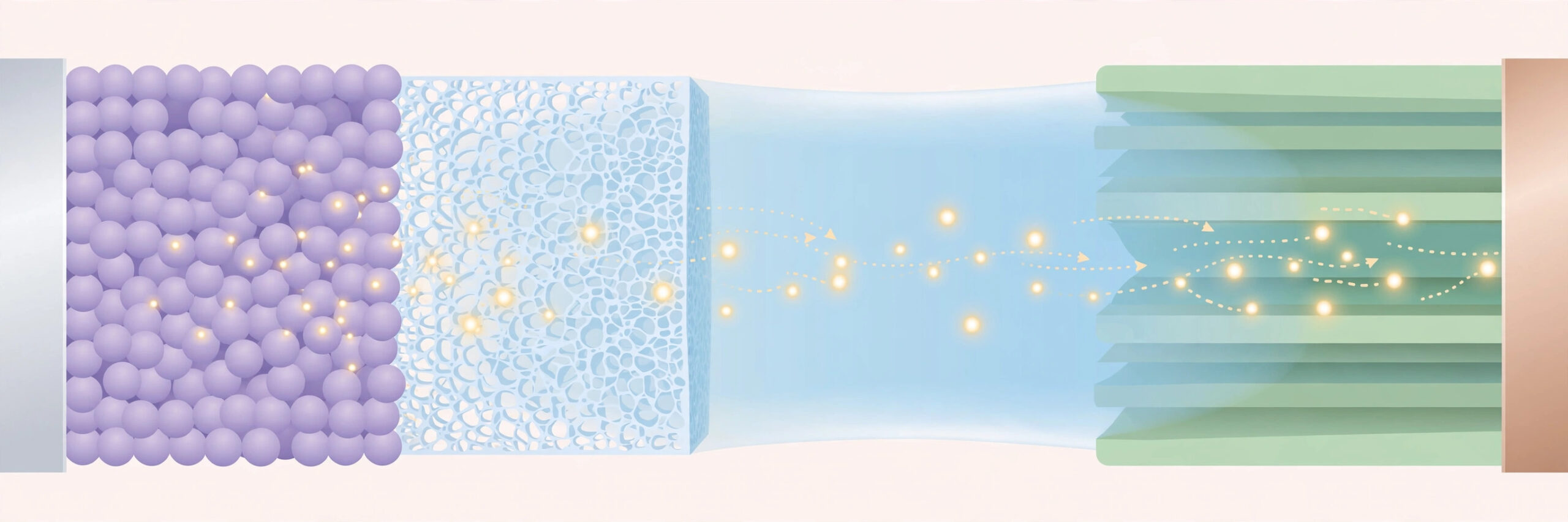
If silicon is so capable, why did phones not use it in 2015? Because silicon has a violent flaw: it swells. When silicon absorbs lithium, it expands dramatically — up to around 300% of its original volume — then shrinks again when the lithium leaves. Imagine a sponge that triples in size every time it soaks up water, thousands of times over. Solid silicon particles crack, crumble and lose electrical contact under that punishment; early silicon anodes destroyed themselves within a small number of charges.
The carbon is the engineering answer to that swelling. Instead of solid chunks of silicon, manufacturers use tiny silicon particles — often nano-sized — embedded inside a porous carbon scaffold. That framework does three jobs at once: it gives the silicon room to expand into empty pores rather than pushing the whole anode apart; it holds the particles in a connected web so they keep conducting electricity as they breathe; and it presents a stable outer surface to the electrolyte, slowing the side-reactions that eat away at battery life. Makers tune the recipe differently, which is why two phones can both advertise silicon-carbon batteries yet behave differently — but the shared idea is always the same: silicon for storage, carbon for survival.
The Honest Size of the Gain
Here is the number that matters, stripped of marketing: in real phones shipping today, silicon-carbon anodes deliver roughly 10 to 20 percent more capacity in the same battery volume compared with a good graphite cell. That is a genuine, useful step — the difference between a 5,000mAh battery and a 6,000mAh one in the same slim phone — but it is not a revolution, and it is certainly not ten times anything.
So how do some phones reach 7,000 or 8,000mAh? By combining the chemistry gain with every other trick available: slightly larger battery compartments won by shrinking other components, and efficient new processors that let makers spend the space on battery instead. The chemistry opens the door; industrial design walks through it. When you see a huge capacity figure, credit the combination — not silicon alone.
Which Phones Are Actually Shipping With It
Silicon-carbon batteries spent years in Chinese flagships before going fully mainstream in 2026. Samsung shipped its first silicon-carbon phones in the Galaxy Z Fold 8 line in July 2026 — significant, because foldables are starved for internal space and Samsung had been one of the most conservative makers on battery chemistry. Late-2026 flagships pushed capacity into territory that would have sounded fictional two years ago: Motorola’s signature 27 arrived in November 2026 with a 7,000mAh cell, and OPPO’s Find X10 Pro Max (October 2026) carries an 8,000mAh battery — both in normal-thickness bodies.
Adoption is uneven, though. Some brands use the extra density to make the battery bigger, as above; others spend it on making the phone thinner while keeping capacity roughly where it was. Both are legitimate — but it means you cannot judge a phone’s battery by the words “silicon-carbon” on the box. You still have to read the actual mAh figure, and a couple of other numbers too.

The Trade-Offs Nobody Puts on the Box
Faster capacity fade over time
The swelling never disappears entirely; it is managed, not eliminated. That constant breathing still stresses the anode more than graphite endures, so silicon-carbon cells can lose capacity faster over hundreds of charge cycles than a mature graphite battery would. If you change phones every two years, you will likely never notice. If you keep a phone for four or five years, it is a real consideration — and the main reason to care about a maker’s battery-health warranty and replacement price.
Cost
Silicon-carbon anodes cost more to manufacture than graphite ones, which is part of why the technology appeared in flagships first. As production scales it is filtering downward, but a very cheap phone claiming it deserves a closer look at its actual capacity and charging specs.
Why some versions of the same phone have smaller batteries
The same model sometimes ships with a smaller battery in one market than another. This predates silicon-carbon — makers have long adjusted cells for regional certification rules, transport regulations and cost targets. The lesson is unglamorous but valuable: check the mAh figure for the exact version sold in your country, not the headline figure from the global launch.
What This Means If You Are Buying in 2026–27
For most buyers, the silicon-carbon shift is good news arriving quietly. A slim phone with 7,000mAh is the clearest signal that the new chemistry is inside — a capacity that was effectively impossible in that body two years ago. Combined with fast charging, it changes habits: overnight charging becomes optional, and heavy days stop being a battery anxiety exercise.
When comparing phones, read the battery page in this order: the mAh capacity of the version sold in your region, the wired charging wattage (how fast a top-up is), and any stated battery-retention guarantee. That third figure, where published, tells you more about long-term value than any launch-day claim. And keep expectations level: silicon-carbon is an evolution of lithium-ion, not its replacement.
Frequently Asked Questions
Is a silicon-carbon battery still a lithium-ion battery?
Yes. The cathode, electrolyte and overall design are conventional lithium-ion. Only the anode changes: part of its graphite is replaced with silicon held in a carbon framework. It is an improved lithium-ion battery, not a different category like solid-state.
Does silicon really store ten times more than graphite?
As a raw material, gram for gram, silicon’s theoretical capacity is roughly ten times graphite’s — but only part of a real anode is silicon, and an anode is only part of a battery. In finished phones, expect about 10 to 20 percent more capacity in the same space.
Will a silicon-carbon battery wear out faster?
It can fade somewhat faster over many charge cycles, because the silicon still expands and contracts with every charge. Good carbon scaffolding and battery management reduce the effect. If you keep phones for years, check the maker’s battery-health guarantee and replacement cost before buying.
Why does the same phone model have a smaller battery in some countries?
Regional certification, transport rules and pricing lead makers to fit different cells in different markets. Always check the capacity of the version sold where you live, not the global launch figure.
Should I wait for solid-state batteries instead?
Solid-state batteries are still not shipping in mainstream phones, and no firm date exists for when they will. Silicon-carbon is available now and delivers a real improvement today — buy on the merits of what is on sale.
Conclusion
Silicon-carbon batteries are lithium-ion with its weakest part — the graphite anode — upgraded. Silicon brings the extra storage, carbon keeps that storage from tearing itself apart, and the result is 10 to 20 percent more energy in the same space, which design turns into the 7,000 and 8,000mAh slim phones of 2026. Read the real capacity for your region, glance at the charging speed and the maker’s battery-health promise, and you will know what a phone’s battery is worth — no headline required.