


Most students use AI the wrong way for studying: they ask it to explain a topic, read the answer, nod, and close the tab. It feels like learning, but almost nothing sticks. There is one rule that separates prompts that actually raise your grades from prompts that just produce nice summaries: the AI must quiz you, not lecture you. Answering a question from memory — even when you get it wrong — is what builds durable memory. Reading a polished explanation is not.
Every prompt below is built on that rule. They work in ChatGPT, Gemini or Claude: copy the prompt, replace the [BRACKETS] with your subject and details, and paste your real material where it says [PASTE]. Used this way, the chatbot stops being an answer machine and starts behaving like a patient personal tutor who never gets tired of asking you one more question.

Tutor Mode: Learn One Question at a Time
1. The one-question tutor — the single most useful study prompt on this page:
Act as my tutor for [TOPIC]. Teach me by asking one question at a time. Start with the basics. After I answer, tell me if I am right or wrong, correct me briefly, and only then move to the next question. Do not give me a lecture or a long summary. If I say “I don’t know”, give me a small hint before the answer.
2. Difficulty control — run the same topic twice, the second pass harder:
Quiz me on [TOPIC] at the level of a [first-year university student / school student in YEAR]. Ask [10] questions, one at a time, and keep a score. When we finish, ask me the questions I got wrong again, but slightly harder, and explain what changed.
3. The explain-it-back check — if you cannot explain it simply, you do not know it yet:
I will explain [CONCEPT] to you in my own words. Your job: listen, then tell me (1) what I got right, (2) what I got wrong or left out, and (3) one question that tests the part I explained weakest. Do not rewrite my explanation for me. Here is my explanation: [PASTE]
4. Analogy first, quiz second — for abstract topics that refuse to make sense:
Explain [CONCEPT] using a simple everyday analogy — something from [cooking / football / running a small shop]. Keep it under [150] words. Then ask me [3] questions that check whether I understood the concept itself, not just the analogy.
Turn Your Material Into Practice
5. Lecture or transcript into a question set — turn passive material into active practice:
Here is a lecture transcript / set of slides about [TOPIC]: [PASTE]. Turn it into [15] practice questions: a mix of short-answer, multiple-choice and “explain why” questions. Do not include the answers yet. When I say “answers”, give me the answer key with one-line explanations.
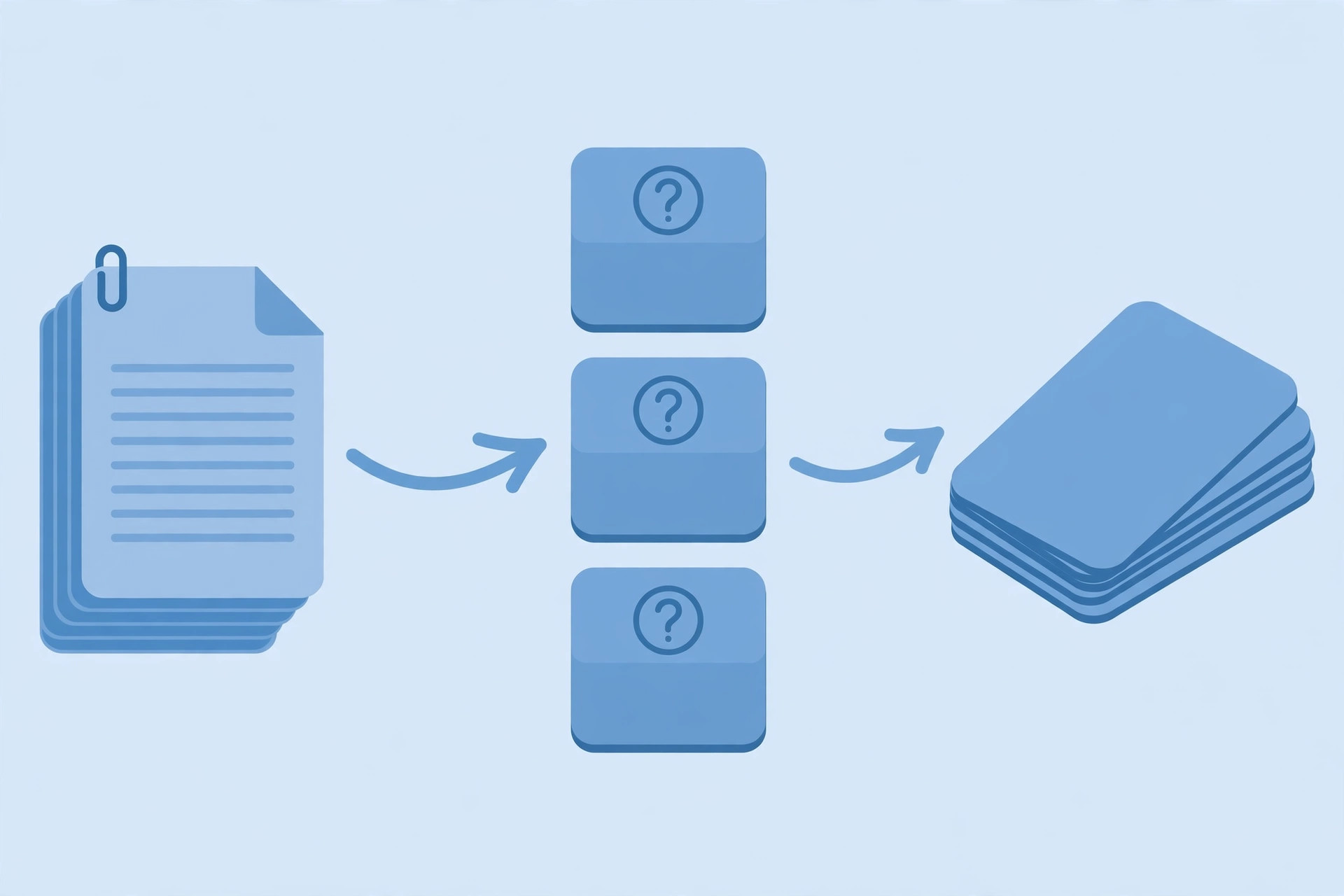
6. Notes into flashcards — the format below pastes cleanly into most flashcard apps:
Turn these notes into flashcards. Output a two-column table: front of card (a short question) and back of card (an answer of one or two lines maximum). Make one card per key fact or definition — no card should test two things at once. Notes: [PASTE]
7. Past-paper style questions — practise in the style of the real exam:
Here is a past exam paper for [SUBJECT]: [PASTE]. Write [5] new questions in exactly the same style, difficulty and marking pattern, but on [TOPIC]. After I attempt them, mark my answers the way this paper is marked and tell me where I lost marks.
8. Worked example, then your turn — ideal for maths, physics, accounting and coding:
Show me one fully worked example of a [TYPE OF PROBLEM] problem, explaining each step in one short line. Then give me a very similar problem and wait. Do not show the solution until I have tried. If I get stuck, give me only the next step, not the whole answer.
Writing & Language Help — Without Cheating Yourself
9. Essay structure coach — guidance on your structure, never a ghost-written essay:
Act as my essay coach for this assignment: [PASTE THE QUESTION]. Help me build an outline: a clear thesis, [4–5] main points, and the evidence each point needs. Ask me questions to sharpen my argument. Do not write the essay, or any paragraph of it, for me — I will write every sentence myself and ask you for feedback on my drafts.
10. Feedback on your own draft — specific, honest, and it leaves your voice intact:
Read this paragraph from my essay: [PASTE]. Give me feedback only: (1) is the main point clear in one sentence? (2) which sentence is weakest and why? (3) any grammar errors, listed one by one. Do not rewrite the paragraph — show me the problems and let me fix them.
11. Language-practice partner — twenty focused minutes beats an hour of vocabulary lists:
Be my [LANGUAGE] practice partner. I am at [beginner / intermediate] level and I can study [20] minutes a day. Build me a daily routine: a few minutes of conversation with me in [LANGUAGE], correcting my mistakes gently after each of my messages; then [5] new useful words with example sentences; then a tiny quiz on yesterday’s words. Start today’s session now.
Exam Week: Plans, Weak Spots and Final Drills
12. Study plan builder — give it a date and a topic list, get a realistic schedule:
My [SUBJECT] exam is on [DATE]. The topics are: [LIST]. I can study [NUMBER] hours a day. Build me a day-by-day plan that covers every topic at least twice, puts the hardest topics earliest, and leaves the final day for revision quizzes only. Present it as a simple table: day, topic, and what to do.
13. Weak-spot finder — your wrong answers are a map of what to study next:
Here are questions I answered wrongly, with my answers: [PASTE]. Find the pattern: which underlying concept am I misunderstanding? Explain that one concept briefly, then give me [5] new questions that target exactly that weak spot.

14. The timed mock exam — rehearse the pressure, not just the content:
Give me a mock exam on [TOPIC]: [8] questions, mixed difficulty, worth [40] marks in total. Show me one question at a time and do not reveal any answers until the end. When I finish, mark everything, give me a score out of [40], and list the two topics I should revise first.
15. Last-day rapid revision quiz — the night before, keep it fast and wide:
Rapid-fire revision: ask me quick questions covering all of [SUBJECT] — definitions, key dates/formulas/facts, and common traps. One at a time, short answers only. Correct me in a single line when I am wrong and keep going. Do not slow down for long explanations; I will ask if I need one. Stop after [25] questions and give me my score.
A Few Honest Notes Before You Start
These prompts are templates, not magic. Three things keep them safe and useful. First, verify the facts: AI assistants sometimes state wrong dates, formulas and definitions with total confidence, so check anything important against your textbook, lecture notes or teacher’s material before you memorise it. Second, the learning happens when you answer — if you let the AI do the explaining, the drafting and the thinking, you are training it, not yourself. Third, you do not need to pay for any of this: the free tiers of ChatGPT, Gemini and Claude all handle every prompt on this page, including pasting in lecture notes and long question sets.
And if prompting works for your studies, it works the same way at a desk job — the same quiz-and-check approach powers our list of 25 copy-paste AI prompts that save time at work. Start with prompt 1, one topic, ten minutes. That is all it takes to feel the difference between reading about a subject and actually learning it.